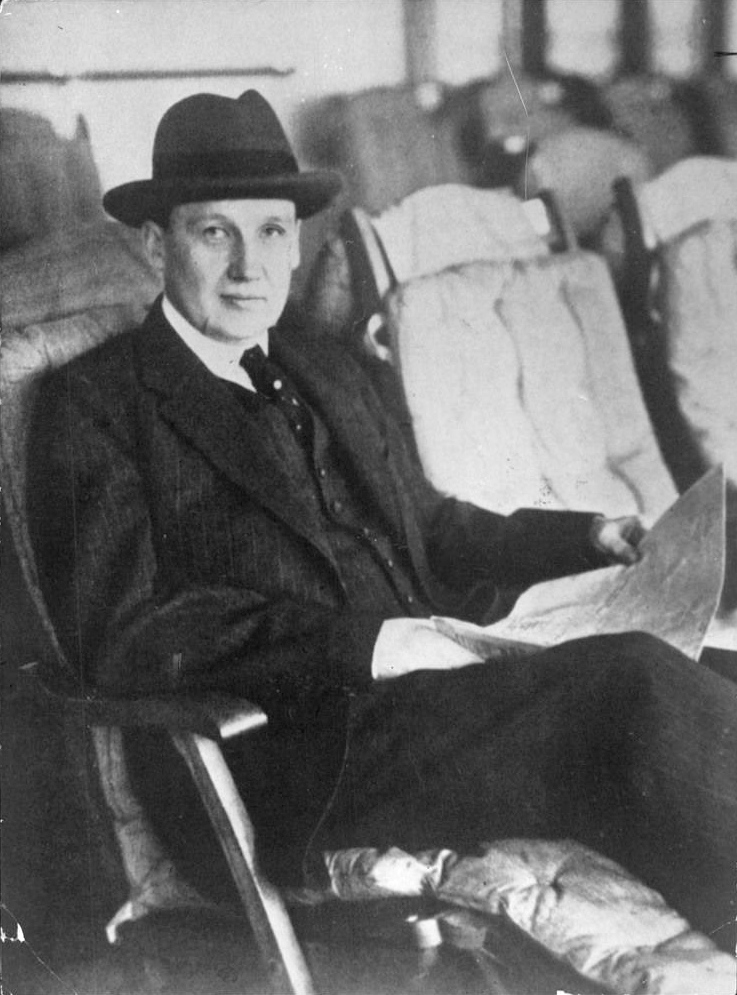
PROFILE
Ivar Kreuger
The Match King
Financier · 1880 – 1932
The Match King: The Fraud That Wrote the Securities Act of 1933
At his peak, one man controlled somewhere between two-thirds and three-quarters of the world's match production.
Not a share of the market. The market. If you struck a match anywhere on earth in nineteen twenty-nine, the odds were better than even that Ivar Kreuger had been paid for it.
He was Swedish, trained as an engineer, and he built that position using a trade so clean it is almost admirable. Europe after the First World War was wrecked and out of money. Governments needed hard currency and could not borrow it. Kreuger had access to American capital, because American investors in the nineteen twenties would buy nearly anything with a story attached.
So he made the offer. I will lend your government millions of dollars, at terms you cannot get anywhere else. In exchange, you grant my company the exclusive legal right to sell matches in your country.
Poland took the deal. France took it. Germany, Greece, Hungary, Romania, Latvia, Turkey, Yugoslavia, Peru, Ecuador, Bolivia. He became a creditor to a continent, and in return he collected national monopolies on a product that every single household on earth had to buy and had to keep buying, because it burns once and then it is gone.
That business was real. That is the part people forget. The matches existed. The monopolies existed. The revenue existed.
What did not exist was most of the money he claimed to be making on it.
Here is how the machine worked, and it is worth following, because every element of it is now illegal, and the law that made it illegal was written because of him.
Kreuger paid his shareholders enormous dividends. Twenty percent and up, year after year, straight through the twenties, in a period when that was extraordinary. Those dividends were the entire sales pitch. American investors saw a company paying twenty percent and bought more.
He was not paying those dividends out of profits. He was paying them out of the money new investors handed him. New securities funded the dividends on the old securities, which advertised the returns that sold the next round of new securities.
To keep anyone from noticing, he built roughly four hundred separate companies. Money moved between them constantly. A loss in one entity was booked as an asset in another. Subsidiaries owned pieces of each other in arrangements no outsider could untangle, and Kreuger made sure no outsider ever got to try. His accounts were consolidated by his own people, on his own terms. He gave auditors summaries instead of ledgers. When pressed, he explained that the secrecy was necessary because his government negotiations were sensitive.
Investors accepted that explanation for a decade, because the checks kept clearing.
He also solved the problem of outside investors gaining any actual control over him. He issued a class of shares that carried the economics of ownership and almost none of the voting power — in some of his structures, one one-thousandth of a vote per share. The public got the risk. He kept command.
If that sounds familiar, it should. The low-vote share class, now standard equipment in modern technology listings, is his design. It is possibly his most durable invention.
By nineteen thirty-one the machine was starving. The Depression had killed his access to new capital, and without new capital there was no way to pay the dividends that were the only reason anyone bought. He needed to show an asset large enough to hold the structure up.
So he sat down and forged Italian government treasury bills. He did it himself, in his own hand, with a face value reported at around one hundred and forty-two million dollars — a sum that in nineteen thirty-one was national-scale money. He even misspelled the names of the Italian officials whose signatures he was faking.
Then he tried to merge one of his companies with the American telecommunications firm ITT, to raise cash. ITT did the one thing nobody had done in fifteen years.
It asked for an independent audit.
The audit found holes. ITT wanted its money back. Kreuger stalled, went to Paris, and on the twelfth of March, nineteen thirty-two, shot himself in his apartment.
Less than two weeks later, investigators from Price Waterhouse reported that his companies were insolvent. The paper that American investors held — some of the most widely owned securities in the United States at the time — was worth a fraction of what they had paid. The collapse landed on a market that had nothing left to absorb it.
Now the part that matters.
Congress was at that moment drafting the first federal securities legislation in American history. The Kreuger collapse arrived in the middle of that drafting, and it functioned as the perfect illustration of every problem the drafters were arguing about. Here was the largest fraud anyone had seen, sold to ordinary Americans, and there had been no mechanism anywhere in the system to catch it.
Look at what the Securities Act of nineteen thirty-three requires and read it as a direct response.
Registration and a prospectus before you sell to the public — because Kreuger sold on a story and a dividend rate.
Financial statements certified by an independent public accountant — because the only audit that mattered was the one he could not control, and it took ITT fifteen years to demand one.
Disclosure of the issuer's structure, subsidiaries, and related-party dealings — because four hundred interlocking companies is where the losses were hidden.
Liability for material misstatements and omissions in the registration statement — because there had been no penalty for a document that lied.
Every one of those requirements is a specific answer to a specific thing Ivar Kreuger did.
Here is the assessment.
He is remembered as a swindler, and he was one. But the reason to study him is not the theft. Ponzi is simpler, Madoff is bigger, and neither of them changed the law the way this man did.
Kreuger is worth knowing because his fraud was wrapped around a real business. The monopolies were genuine. The factories ran. The matches sold. He did not invent a fake company. He took a legitimate and genuinely clever enterprise and financed it with a lie, and the legitimacy of the underlying operation is exactly what made the lie survivable for fifteen years.
That is the harder lesson and the one that stays useful. Frauds that look like frauds get caught early. The ones that last are attached to something that works, run by someone who is actually good at the business, and they are discovered only when somebody with leverage finally insists on seeing the books.
Nobody insisted for fifteen years, because he was paying twenty percent.