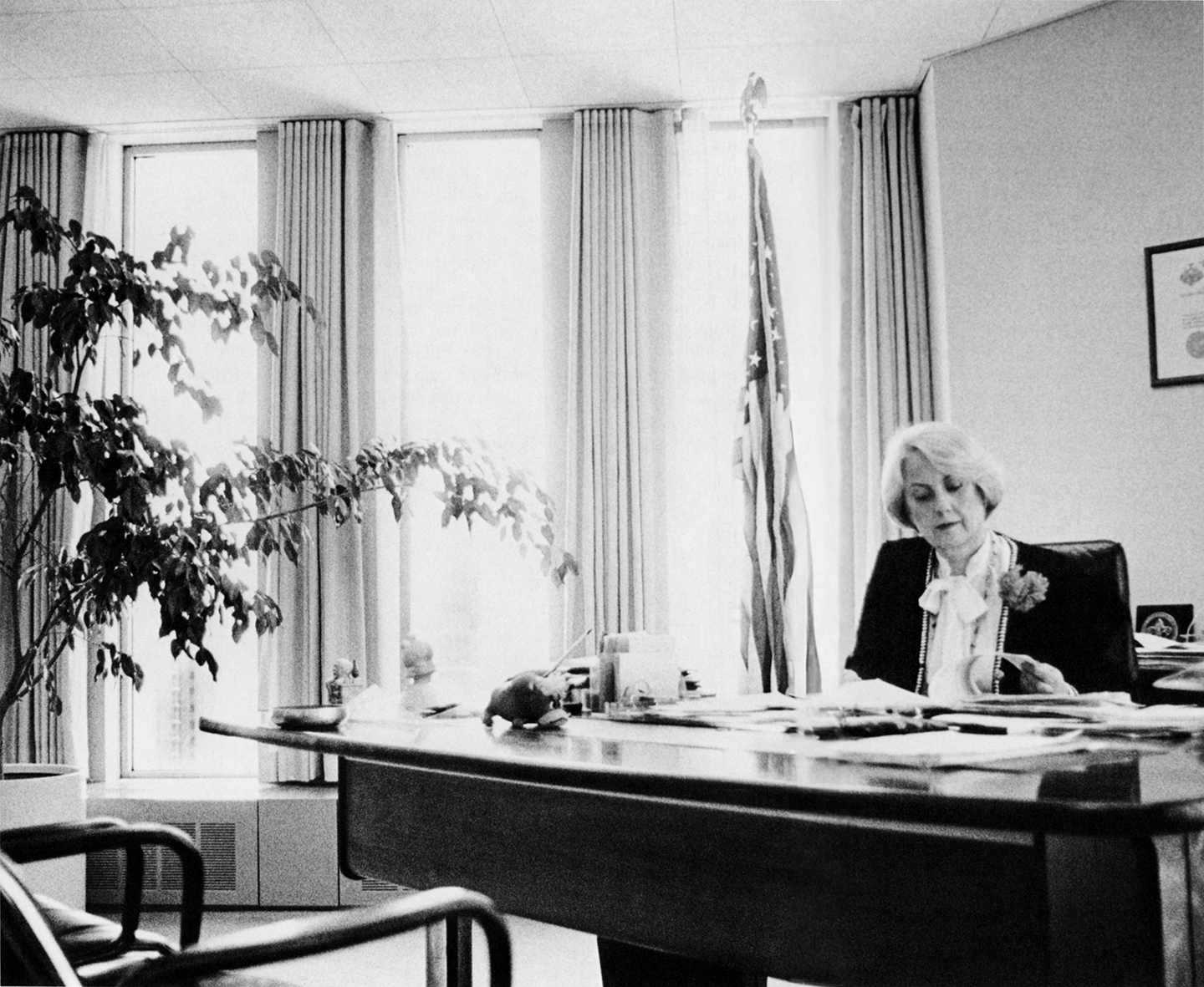
PROFILE
Muriel Siebert
The Tenth Man
First woman member, New York Stock Exchange · 1928 – 2013
The Tenth Man: Muriel Siebert and the Price of Admission
To join the New York Stock Exchange in nineteen sixty-seven, you needed two things.
You needed to buy a seat, which was expensive. And you needed an existing member to sponsor your application, which was free, and which turned out to be the harder of the two.
Muriel Siebert asked nine men to sponsor her.
All nine said no.
The tenth said yes.
She was born in Cleveland in nineteen twenty-eight. She went to Case Western and left without finishing. She drove to New York in a used car with five hundred dollars and started looking for work as a securities analyst, and when she filled out applications she learned quickly that putting "no degree" on the form ended the conversation, so she stopped putting it on the form.
She got hired as a trainee analyst at sixty-five dollars a week. She was good at it — genuinely good, specializing in airlines at the moment the industry was being remade by jets. She moved firms several times, because moving was the only way to get paid, and she noticed something each time she moved. The men doing her job, at her level, with her results, were making roughly twice what she made.
At one point she applied to a firm and was told directly that the partners were not going to hire a woman for that role.
So in nineteen sixty-seven she decided to stop asking to be let in and to buy her way in instead.
The seat cost four hundred and forty-five thousand dollars. The exchange also required that three hundred thousand of that come from a bank loan.
Read that requirement carefully, because it is the trap. The banks would not lend her the money until she was a member of the exchange. The exchange would not make her a member until she had the loan from a bank. Each institution pointed at the other. That arrangement is not written down anywhere as a rule against women. It did not need to be. It simply produced the correct outcome on its own, every time, without anyone having to say the quiet thing out loud.
It took her two years to break it. Chase Manhattan finally lent her the money.
On the twenty-eighth of December, nineteen sixty-seven, Muriel Siebert became a member of the New York Stock Exchange. There were more than thirteen hundred other members. All of them were men.
She was the only woman on that floor for the next ten years.
There was no women's restroom near the luncheon club. She has told the story of what that meant in practice, and it is a small detail that explains the whole institution: the building itself had been designed on the assumption that she would never be in it.
Now the part that makes her more than a first.
On the first of May, nineteen seventy-five, fixed commissions ended. For a hundred and eighty-three years every member firm had charged the same published rate to execute a trade, and that morning it became negotiable. Most of Wall Street responded by raising prices.
Siebert converted her firm to a discount brokerage that day. Not the following quarter. That morning.
People at her own clearing firm told her it would ruin her, and one of them dropped her. She did it anyway, because she had concluded that a fixed commission was a subsidy the customer paid to the industry, and that the moment it became optional it was going to disappear whether or not the floor approved.
In nineteen seventy-seven the governor of New York appointed her Superintendent of Banking for the state — the first woman in that job as well. She held it for five years, through a period of very high interest rates and considerable stress in the banking system, and she oversaw the institutions of the largest financial state in the country during it. She had to put her firm in a blind trust to take the post.
She went back to the business afterward, took her company public, and spent the last stretch of her career on financial literacy education for schoolchildren, on the argument that money was the one subject the schools had decided not to teach.
She died in twenty thirteen, at eighty-four.
Here is the assessment.
The barrier she hit in nineteen sixty-seven was not a rule. Nobody had written down that women could not own a seat. What existed instead was a set of ordinary-looking requirements that, arranged in a particular order, could not be satisfied by anyone the members did not already want. Nine refusals. A loan you cannot get without membership, and a membership you cannot get without the loan. Every piece defensible on its own. The combination airtight.
She did not argue with it. She found the tenth man, got the loan, paid the four hundred and forty-five thousand, and walked onto the floor.
Eight years later, when the industry's own protective arrangement came apart, she moved first — because someone who has spent a decade as the only one in the room owes the room's customs nothing.
The outsider is the one who cuts the price. Insiders are the ones with something to protect.